
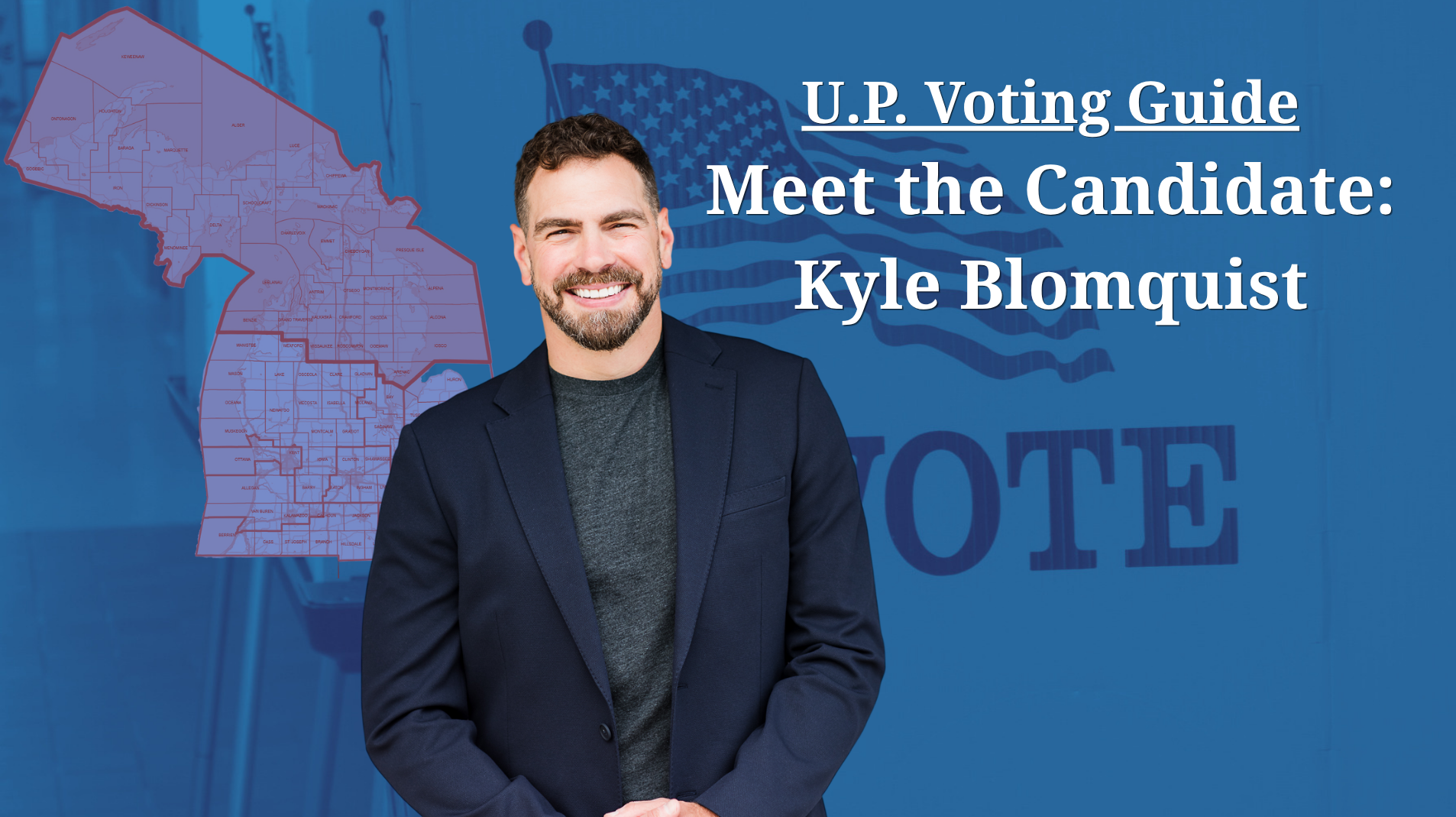
LANSING, Mich. (WZMQ) – Michigan’s 1st Congressional District covers the entire Upper Peninsula and much of northern Michigan, making it one of the largest U.S. House districts east of the Mississippi River. Republican incumbent Jack Bergman is seeking another term. Kyle Blomquist, an architect and Iron Mountain City Council member, is one of three Democrats running for the party’s nomination. Michigan’s primary is Aug. 4, with early in-person voting already underway.
Q: Tell me a little about yourself: where you’re from and what made you decide to run for office.
My name is Kyle Blomquist. I’m running for Congress here in Michigan’s 1st Congressional District for the U.S. House of Representatives. I was born and raised in Iron Mountain, so I’m a lifelong Yooper. I’ve served on the Iron Mountain City Council for about 12 years, including six years as mayor pro tem. I’m an architect by trade. My wife and I met in architecture school in Milwaukee, and we have two young boys.
Really, I’ve watched my neighbors’ material conditions here in the Upper Peninsula and northern Michigan deteriorate for most of my life. Things are getting worse, not better. Our hospital systems are closing, our housing is becoming grossly unaffordable, and so much of our lives are being paywalled for profit.
I want to undermine that system that has abused so many of us and make sure prosperity is the default rather than a matter of luck in this country.
Q: This seat has been held by Jack Bergman for several terms. What’s your message to voters about why you’re the strongest candidate in this race against Bergman?
We’ve seen Jack’s leadership has not really been leadership at all. I think his priority is sucking up to Donald Trump and being a sycophant to that administration. He thinks less about our people here in the Upper Peninsula and northern Michigan and more about his benefactors at Raytheon, Northrop Grumman, and AIPAC.
He would rather send our tax dollars abroad to bomb children on the other side of the world than take care of our children here in America.
That’s a dynamic we need to change, and I believe I’m the only candidate in this race who’s actually proposing meaningful change and an affirmative vision for what America can be, rather than just focusing on all of Jack Bergman’s flaws.
The reality is that Jack Bergman is a flawed leader. He has led us down a terrible path that has contributed to the lack of affordability in our lives. He has contributed to systems that have exploited people across this state and throughout the country.
But Jack Bergman is indicative of a larger system, presided over by many Republicans and Democrats, that tells us too often that better is impossible and the best we can hope for is something we lost over the last 10 years, something that probably wasn’t that great to begin with.
Q: How would you work with lawmakers across the aisle to bring resources and benefits home to Michigan?
I think we first have to acknowledge the challenges we have here in northern Michigan and the needs we have.
When I look at our dam infrastructure and the recent flooding events we’ve experienced, we need infrastructure spending here in northern Michigan to make sure we’re resilient and proactive, especially with climate change leading to more frequent disaster events that are beginning to undermine our infrastructure.
We need to make those investments on the front end rather than having to repair everything in an emergency on the back end.
I also think we need to expand services, including rural broadband and reliable cell service throughout this district. As somebody who’s painted this district with three coats by now, both in the Upper Peninsula and the Lower Peninsula, I can tell you that you can barely drive for 30 minutes in either direction and maintain cell coverage.
That’s something we’ve continued to wait for private companies to expand, and I believe we should invest in any number of sectors to make sure that if somebody needs a service, it can’t simply be withheld from them.
Q: Housing: What federal role do you see in addressing housing access and affordability in northern Michigan and the U.P.?
We’ve seen housing in this country become deeply commodified. Instead of homes being primarily for the people who live in them, or investment vehicles that help young families build equity, which is how many Americans have historically built household wealth, they’ve become speculative investments for large developers, private equity firms, and affluent people purchasing Airbnbs.
I believe we should regulate short-term rentals to make sure they don’t have an outsized influence on our housing market, so more homes are reserved for young families and people on fixed incomes who want to become homeowners.
I also believe we should ban private equity from owning single-family homes and begin reducing its ownership of so much of our nation’s housing stock. That would immediately return many of those homes to working-class families.
I believe we need to treat the housing crisis like the crisis it is. That means directing federal resources toward addressing it. For me, that means repealing the Faircloth Amendment so we can once again build quality, affordable public housing with deep affordability and make sure people who work in their communities can also afford to live there.
Q: Healthcare: Given rural hospital, labor and delivery, and obstetrics closures, along with rising healthcare costs, what’s your approach to healthcare at the federal level?
We need policy that actually guarantees healthcare for everybody from birth to death without the risk of claim denials, care avoidance, or medical debt.
We need to make it so your taxes cover your healthcare without burdensome out-of-pocket costs that allow private health insurance companies to profit by denying care.
We’ve seen how our healthcare system has been built around profit rather than care. We’ve seen private healthcare systems buy up local providers and then take many of them offline so they can drive us, who they see as customers, farther and farther to receive care.
I believe we need Medicare for All to guarantee healthcare. Medicare for All would also improve Medicare itself by removing the need for expensive supplemental plans.
It would also eliminate situations where someone from the Upper Peninsula can seek care in Green Bay, Appleton, or Milwaukee, but once they cross the Wisconsin border they’re suddenly outside their healthcare network and their out-of-pocket costs double.
We have healthcare deserts throughout this district, whether for obstetric care or primary care. If you have to travel farther and farther to receive healthcare, eventually your health deteriorates, and your quality of life suffers.
I believe we should fill those healthcare deserts with publicly owned and operated clinics to guarantee people throughout this district have healthcare services available to them.
Follow-up: The interviewer asked about the broader economic impact of losing rural healthcare services.
We’ve seen it, it doesn’t matter what your employment situation in your community is. You need that kind of three-legged stool of quality health care, affordable housing, and quality education.
If any of those pieces start to be deteriorated, then all the rest start to fail as well. And then it doesn’t matter what the size of that employer is. They’re not going to be able to hire new people to come into your community, and your community will slowly die.
That’s something that we’ve seen throughout this district: communities starting to die because they do not have adequate health care services.
When you’re an elderly person, you should be able to kind of move wherever the hell you want in this country, especially in places like Northern Michigan that have this natural beauty that people want to tap into. But if they come up here and they can’t get the care that they need, especially as they’re getting in an advanced age, or you’re a young family, and you don’t have any place where your babies might get delivered, or your children might be taken care of in terms of pediatric care, you are not going to move to those communities.
Those communities are going to slowly kind of wither away.
We’ve seen that throughout this district, and I believe that we should start to fill those deserts with nodes of care.
If a private health care system deems our neighbors’ care unprofitable to them, then fine, exit that market. But we should make sure that the federal government’s responsibility is to make sure those people still get care.
Q: Energy: Where do you stand on keeping natural gas plants running versus expanding renewable energy in the Upper Peninsula?
Context given: The interviewer referenced the RICE generators and the debate over balancing existing natural gas generation with renewable energy expansion.
I think we need to start moving toward green energy so we can not only employ people here in our own communities, but also build a more resilient energy grid by diversifying our energy sources. We need to break our dependence on fossil fuels, and we can do that while existing resources, like the RICE generators, continue to operate.
If we’re able to get that renewable infrastructure online, the need for those natural gas generators becomes less necessary. What I want to make sure of is that we’re taking care of people now and into the future. We need to start thinking about the future. We can’t always cling white-knuckled to what we have because resources are scarce.
Too often we allow private utility companies to dictate the pace of our growth and the pace at which we reduce our dependence on them. I think we should completely break from that.
I support a Green New Deal, which would invest in our communities, create jobs for us and our neighbors, and establish public green utility companies that could compete with DTE and other service providers. Rather than spending taxpayer dollars to expand their monopolies and tighten their control over our communities while they continue asking for rate increases, I want to see the opposite.
I want to see us moving toward a greener future without dependence on fossil fuels, and in doing so, give people more control over their energy.
Q: Data centers: What role, if any, should the federal government play in regulating data center development?
I think we need to regulate data centers at the federal level. We should make sure there’s parity between states. We can’t continue this race to the bottom.
Right now, here in Michigan, because the current administration and state Legislature passed these tax breaks, we’ve seen an influx of data centers that have led to a number of negative impacts on neighboring communities. Whether it’s overriding local control, as we saw in Saline Township, or what we’ve seen here in the Upper Peninsula with Lake Superior Academy in the eastern U.P., there are real consequences.
Lake Superior Academy is a Montessori school whose curriculum is built around getting children outdoors, into the beauty of the Upper Peninsula, and teaching them to be self-sufficient and self-reliant. Instead, we’ve built a Bitcoin mining operation across the street that’s producing between 50 and 80 decibels of noise. Those children can’t fully enjoy the beauty of the Upper Peninsula because of a cruel business decision someone else made, and there’s virtually no regulatory framework to prevent that from happening.
I support a full federal moratorium on data centers.
Right now, we have roughly 12 times the number of data centers as China. Either we’ve failed to meet demand by building inefficiently, in which case we should slow down and reevaluate, or we won that arms race a long time ago because we already have an outsized physical infrastructure.
First and foremost, I want to make sure our communities are protected. I want to make sure our environment is protected, that data centers can’t drain our aquifers, pump heat and noise into our communities, drive up our energy rates, or use artificial intelligence primarily to make the American working class obsolete.
I want to make sure more people are employed, working less, and being compensated more, instead of what billionaires want, which is the opposite. They want to lay off more workers, make us more desperate for jobs, and make us more afraid of being next on the chopping block so we’ll accept lower compensation while working harder.
That’s been the dynamic in this country as productivity has increased. Big Tech has siphoned off more of the value created by workers while keeping the American working class economically insecure. That’s a dynamic we need to turn upside down.
Follow-up: The interviewer asked whether economically struggling rural communities are especially vulnerable to these developments.
Absolutely.
We need to raise the floor for the American working class. We need to make sure everyone’s basic needs are met by default. Everything above that becomes growth and prosperity.
Instead, we live under what feels like the economic violence of poverty. We’re always negotiating from a position of weakness instead of strength.
The same dynamic applies to data centers, the Copperwood Mine, and the Line 5 pipeline. We’re often promised a handful of short-term jobs in exchange for mortgaging our once-in-a-planet natural resources, our environment, and the future of our children and communities.
That’s not a tradeoff we should be making. To avoid feeling forced into those decisions, we need to improve everyone’s quality of life so communities aren’t negotiating from desperation.
Q: Mining: What’s your stance on mining in the U.P., including the proposed Copperwood project near the Porcupine Mountains?
My belief is that mining can be done conscientiously. It can be done in a way that doesn’t poison our environment. But that should be the standard. That should be a requirement, not an option.
Right now, my concern is that, with the Trump administration undermining the EPA, we don’t necessarily have a cop on the beat.
The proposal near the Porcupine Mountains, along Lake Superior, would place a mining operation closer to Lake Superior than any mining operation before it. That’s being done for a foreign mining company, Highland Copper, which has what I believe is an incomplete record of operating a mine at that scale and has questionable resources. At the same time, we’re expecting the State of Michigan to pay for much of the infrastructure supporting that project.
As far as I’m concerned, mining proposals need to be evaluated on a case-by-case basis, making sure we’re protecting our environment for future generations and ensuring that the people of northern Michigan are ultimately the ones who benefit. It can’t always be an extractive relationship.
More than anything, I want to make sure it’s the people here in northern Michigan who are taken care of. We should have good jobs while also ending up with a clean environment afterward.
We can’t continue allowing foreign extraction companies to come into our communities, profit from our natural resources, and then leave us 10 years later to deal with the consequences.
If we’re going to welcome any industry, and I do welcome industry, I want to make that extremely clear, the standard is straightforward. Our working-class communities need to benefit first, and our environment needs to be protected.
As long as those two standards are met, I welcome any industry that wants to come here.
Q: Defense: Would you support renewed investment in K.I. Sawyer, and how would you work with Upper Peninsula Republicans on a project like this?
I’d welcome reinvestment in K.I. Sawyer.
My broader belief is that we need to begin dismantling what I see as our war engine. Every budget cycle, we continue increasing military spending, which I believe incentivizes violence around the world while directing more profits to corporations like Raytheon, Northrop Grumman, and Boeing.
We can’t continue this feedback loop where politicians, like Jack Bergman, receive support from the defense industry and then direct more taxpayer dollars back into that industry while so many other needs go unmet.
When it comes to K.I. Sawyer specifically, I’d love to see it brought back into use because I’d like to see American service members stationed abroad brought home to serve closer to their own communities. We shouldn’t have hundreds of military bases overseas.
The larger question is whether we’re also investing in housing, hospitals, schools, and other infrastructure to support those additional residents. I believe we absolutely can.
Bringing American service members back stateside could be a tremendous benefit to communities in the Upper Peninsula, as long as it doesn’t become a burden.
We’ve seen with investments like the Soo Locks that if we don’t prepare for an influx of workers and families, the housing market becomes overwhelmed. We need to make sure those investments are a net positive and that we don’t create unintended consequences by failing to meet the infrastructure needs that come with growth.
Q: Give me your elevator pitch. What do you want Democrats, Republicans, and independents to know about you and your campaign?
Really my belief, my general belief is this: is that this partisanship is fake.
That it is something that’s imposed upon us, and it causes us to see enmity in our fellow man.
That’s where we start: when there is an ice storm, an erosion event, or a death in the family, regardless of how someone voted in the last election, that we’re always there for one another.
We’re there with our chainsaw clearing the other person’s road even though they vote differently than us.
We’re plowing out their driveway if they’re sick and they’re unable to do so.
We start a meal train if there’s a death in that family.
That’s where we’re at as human beings.
It’s this partisanship that is thrown in by very powerful people to keep us divided.
My elevator pitch is this: We deserve so much more than we’re getting from our government, and our government is too often prioritizing profit and violence over the well-being of its own people.
Then it uses these partisan divides deliberately to keep our eye off the ball.
I’m running as a Democrat in this race. But I don’t believe that any label, Democrat, Republican, progressive, conservative, that matters in the least when it comes to meeting someone’s needs and taking care of them and making sure that their families are prosperous by default.
My general belief is I don’t care if your collar is white or blue. If you sell some of your finite time on this earth for a dollar and at any point you stop, this system abuses you, jails you, and forgets you. Congratulations, we’re in the American working class.
By that definition, that’s 90% of us, and we have a tremendous amount of power and agency as long as we start looking at each other as allies rather than enemies.
Q: Is there anything else you’d like voters to know?
More than anything, I want to make sure our needs are met here at home.
I want to see more of our tax dollars invested in building our roads, hospitals, schools, and homes here in America rather than being spent overseas.
I want government to prioritize the American working class over the investment class and Wall Street.
The only way to make sure your elected officials aren’t bought is to make sure they’re not for sale. I’ll never accept money from corporate PACs, foreign lobbying groups, or leadership PACs backed by institutional politicians who have spent decades in office and whose fingerprints are all over the conditions we’re living under today.
You can read more about Kyle Blomquist on his campaign website: blomquistforcongress.com
Blomquist is facing Democratic opponents Wayne Stiles and Callie Barr in the Aug. 4 primary. Republicans on the ballot are incumbent Congressman Jack Bergman, Justin Michal, and Matthew DenOtter.
Information about every candidate on the ballot is available in WZMQ 19’s 2026 Primary Voting Guide.