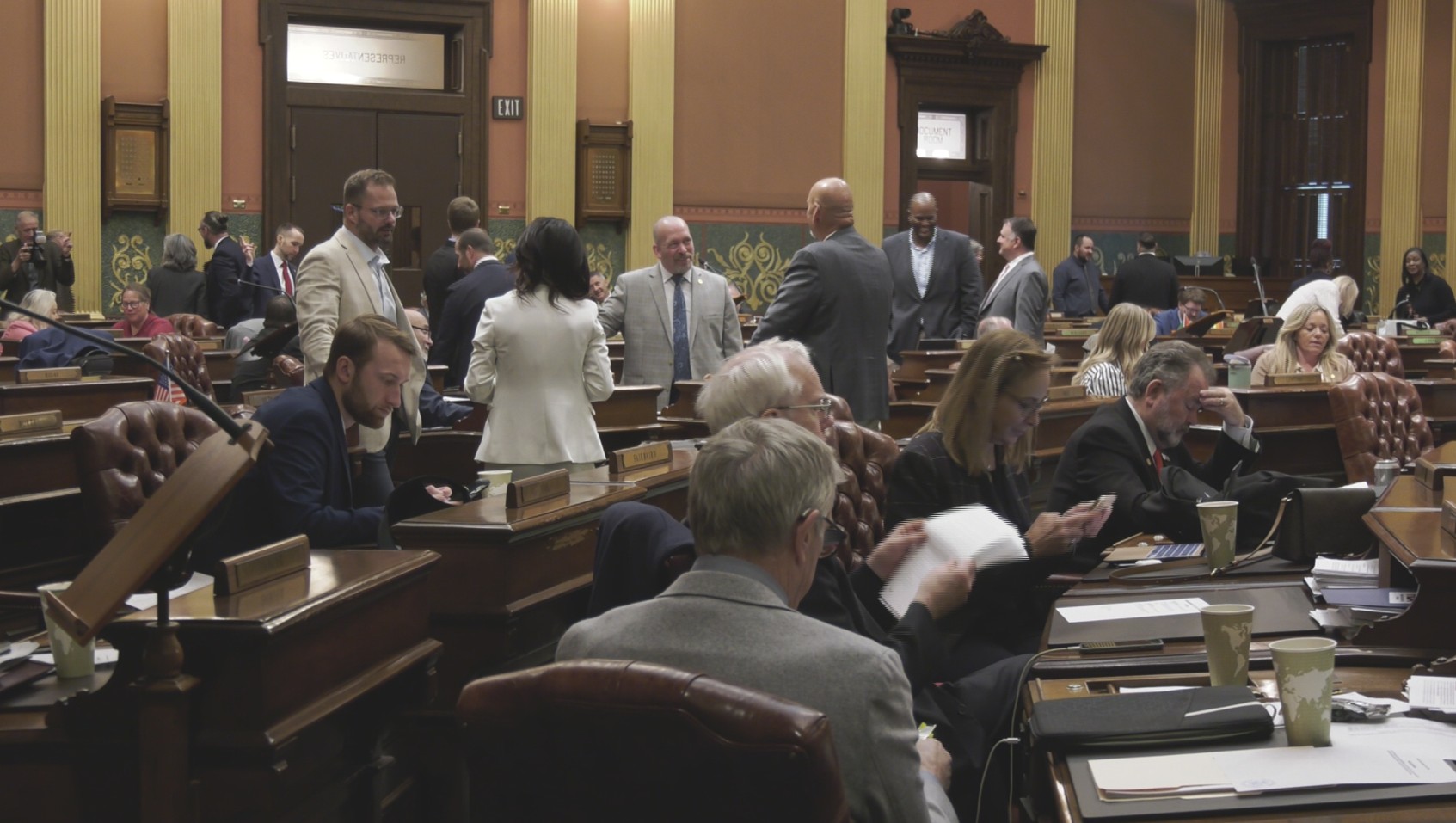
LANSING, Mich. (WZMQ) – After nearly 24 straight hours at the Capitol, Michigan lawmakers approved an $84 billion bipartisan state budget early Friday morning, wrapping up weeks of negotiations just days after missing the state’s July 1 budget deadline.
The spending plan balances the state’s finances without raising taxes or withdrawing money from Michigan’s rainy day fund, officially the Budget Stabilization Fund. It also marks the second straight year lawmakers have reduced the state’s core appropriated budget.
The budget is officially listed at $75.2 billion in appropriated spending, but that figure excludes certain Medicaid provider tax revenue and other spending that will still flow through state government during the fiscal year, bringing total spending to roughly $84 billion.
House Republicans entered negotiations promising to shrink the budget, avoid tax increases and protect the state’s emergency savings account. Senate Democrats focused on maintaining investments in education, health care and other core services despite slowing state revenues and uncertainty surrounding future federal funding.
“This is by far the best budget deal that I’ve negotiated,” House Speaker Matt Hall, R-Richland Township, said after lawmakers approved the plan. “It’s probably the most decisive budget victory for the Republicans.”
Hall said the agreement proves lawmakers could reduce spending without raising taxes.
“We didn’t have to raise taxes. We didn’t have to take money out of the rainy day fund. We could deliver a more efficient budget that provides a lot of good services,” Hall said.
Senate Appropriations Chair Sarah Anthony, D-Lansing, said both parties ultimately found common ground.
“I think this was the most bipartisan budget that we’ve passed out of this chamber,” Anthony said. “That’s a testament to a lot of compromising, not necessarily compromising our values, but making sure that we could meet in the middle.”
What it means for Michiganders
For most Michigan residents, the budget’s effects will be felt through continued investments in health care, roads, higher education, and public safety, while some state agencies will need to adjust to reduced funding levels.
The Whitmer administration says the budget continues free school meals, the Michigan Achievement Scholarship, Michigan Reconnect, road improvements, public safety investments and Medicaid services while preparing the state for changes to federal health care and food assistance programs.
Gov. Gretchen Whitmer called the agreement a balanced budget that “delivers for every Michigander.”
“Today’s balanced, bipartisan budget delivers for every Michigander,” Whitmer said in a statement. “This budget builds on our progress by strengthening student literacy, opening doors for more housing opportunity, protecting health care, fixing our damn roads, and lowering costs for all Michiganders.”
Where the money is going
The budget includes approximately $52.3 billion for state departments and $22.9 billion for schools, community colleges, and universities.
While lawmakers reduced overall appropriated spending, several major departments received additional funding.
The largest increase goes to the Michigan Department of Health and Human Services, whose budget grows by more than $681 million, increasing from about $30 billion to $30.7 billion.
According to the Whitmer administration, that funding will help stabilize Medicaid, prepare Michigan for new federal Medicaid and SNAP requirements, expand behavioral health services, continue wage increases for direct care workers and maintain maternal health programs.
Transportation also received one of the largest increases, growing by nearly $227 million. The budget includes additional funding for road repairs, bridge improvements, public transit, and rail projects.
Other departments receiving funding increases include Corrections, the Department of Attorney General, Civil Rights, the Department of State, Insurance and Financial Services, the Department of Lifelong Education, Advancement and Potential, and Natural Resources.
Several agencies will receive less funding
Not every department saw an increase.
The Department of Environment, Great Lakes and Energy received the largest reduction, losing nearly $296 million compared to last year.
Other departments seeing decreases include:
- Technology, Management and Budget
- Labor and Economic Opportunity
- Military and Veterans Affairs
- State Police
- Agriculture and Rural Development
- Education
- Treasury
- Judiciary
- Licensing and Regulatory Affairs
Hall argued many of those reductions came from eliminating unnecessary spending and improving oversight of state programs.
Anthony said lawmakers faced difficult decisions because revenue projections were tighter than in recent years.
“There wasn’t a ton that we had to say goodbye to,” Anthony said. “We weren’t able to make significant investments in things that I really care about,” pointing to local revenue sharing and water infrastructure.
Schools see funding changes
Education funding accounted for many of the biggest changes in this year’s budget.
The state approved a $250 increase in the per-pupil foundation allowance, bringing state funding to $10,300 per student, while also continuing universal free school meals, literacy initiatives, tutoring programs, mental health services and special education funding.
On paper, the School Aid budget drops from about $21.3 billion to $19.8 billion, a decrease of roughly $1.5 billion.
However, much of that reduction reflects accounting changes rather than an equivalent cut to classroom spending.
Lawmakers reduced certain federal spending authorizations while simultaneously allowing schools to spend all available federal education dollars. As a result, actual school spending could ultimately be higher than the budget documents initially suggest.
Anthony acknowledged lawmakers shifted money within education accounts to help balance the budget.
“We did shift some funding from the School Aid Fund, and that also includes some post-secondary funding shifts,” Anthony said. “We unfortunately had to make the math work. What we didn’t do is raise taxes or take money from the rainy day fund.”
Community colleges received about $3.6 million more than last year, while Michigan’s public universities saw an increase of nearly $273 million, preserving funding levels after House Republicans had previously proposed much larger reductions.
The budget takes effect Oct. 1, the start of Michigan’s 2026-27 fiscal year.
As state agencies begin implementing the spending plan, lawmakers say the next challenge will be determining how the reductions affect individual programs while continuing to balance the budget amid uncertain federal funding and slower revenue growth.