
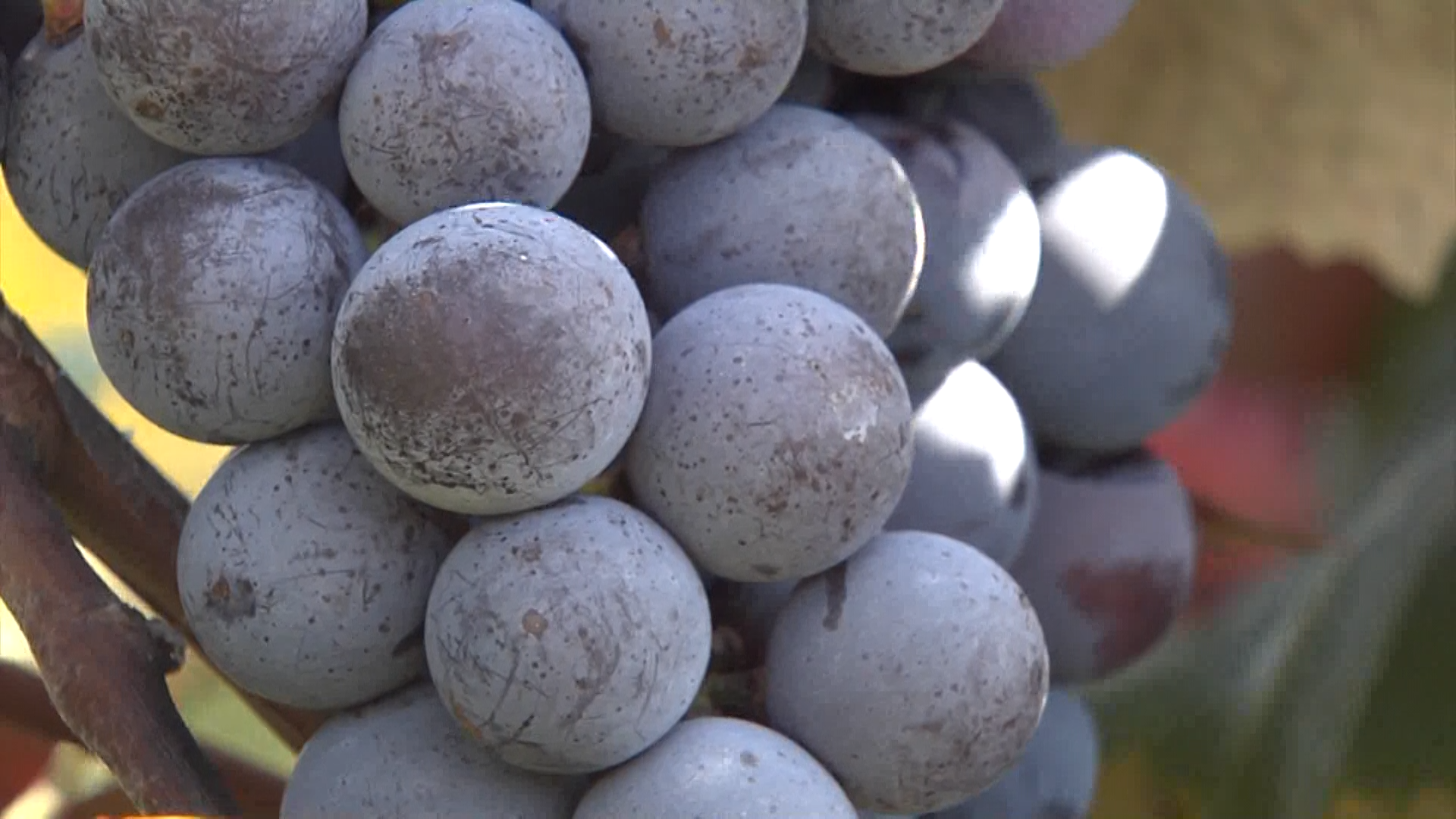
WASHINGTON, D.C. –– The federal government is stepping in to purchase a large amount of Concord grapes after a major processor pulled out of the region in March. But some growers say the purchase will not address the root of the problem.
In March, beverage giant Refresco canceled 126 contracts across the Lake Erie Grape Belt. The move left Concord and Niagara grape growers in New York and Pennsylvania scrambling for a market and asking: who will purchase this year’s harvest?
Farmers, like Nick Mobilia, a third-generation grape grower, received a familiar answer to that question Tuesday.
“I graduated in 1970 and I’ve been here ever since,” said Mobilia, who owns Arrowhead Wine Cellars and Mobilia Fruit Farms in North East, Pa., in the heart of the Lake Erie Grape Belt.
Mobilia has seen a lot over nearly six decades of growing, harvesting and selling grapes — including a recent decrease in demand for products like grape juice and jelly. But one of the biggest blows came in the spring, well into this year’s season, when Refresco informed Mobilia and other growers that their contracts would be terminated due to “sustained grape market challenges and supply imbalances.”
Mobilia understands that processors are dealing with supply imbalances — working to manage and reduce supplies, while trying to build demand. Managing the issues can result in tough choices, as local growers found out in March. That being said, Mobilia and others are upset with Refresco’s timing.
“I was caught off guard,” said Mobilia. “If you knew you were going to do it, you should have done it right after the harvest because everybody spent three or $400 an acre trimming and pruning and fixing the trellis and everything. And then you get the news that, well, all that work I just put in these 50 acres don’t have a home. You know, that that hurt.”
On Tuesday, the U.S. Department of Agriculture (USDA) announced it will purchase $20 million worth of grape juice from the region. The money comes through Section 32, a federal program that allows the USDA to buy surplus farm products for domestic nutrition programs.
Lawmakers from both parties — including Congressman Nick Langworthy, R-N.Y., and senators Kirsten Gillibrand, D-N.Y., and Minority Leader Chuck Schumer, D-N.Y. — had been pushing the USDA to make the purchase for months.
“This is a win for Upstate farmers, families, and New York’s economy. I’ll keep fighting for our growers and a stronger domestic food supply chain,” said Leader Schumer.
“I am thrilled that the USDA answered our call by enacting Section 32 of the Agricultural Adjustment Act to support Upstate New York’s growers during this critical time. This decision delivers relief to our local farming families and protects a critical part of New York’s agricultural economy,” said Sen. Gillibrand.
It’s not the first time the federal government has stepped in to assist the industry, and it may not be the last. The USDA has used similar Section 32 purchases for Concord grapes six times since 2006 — most recently in 2024.
Mobilia is grateful for the help but added that it’s a short-term fix for a long-term problem.
“Their help is short term. We appreciate it. Absolutely,” he said. “The problem is an industry problem, not a processor or a farmer problem, it is an industry problem.”
“When they distribute this juice, like the school districts and universities and hospitals, we need to be at the door saying, ‘Okay, let’s quit relying on the government to do it. Let’s do it ourselves.’ That takes the government out of it, but they have to be able to open the door for us to do that,” Mobilia added.
“The Lake Erie Grape Belt is an important part of our agricultural heritage and a major economic driver for communities across Western New York. Our family farms have weathered difficult markets before, and we are going to do everything we can to make sure this industry has a future here,” said Rep. Langworthy.
Mobilia also hopes the industry has a future in the Lake Erie Grape Belt so that his family’s legacy can continue to be passed down to the next generation.
“I’m the third generation on this property. My grandfather got it back in 1919,” said Mobilia. “My dad had it and now I have it and my kids are going to take it over, so hopefully we can keep it rolling.”
Even though the USDA’s purchase will help move much of this year’s harvest — growers have expressed concerns that the purchase won’t replace the processing capacity lost in the Lake Erie Grape Belt, which is home to nearly 30,000 acres of Concord grapes.