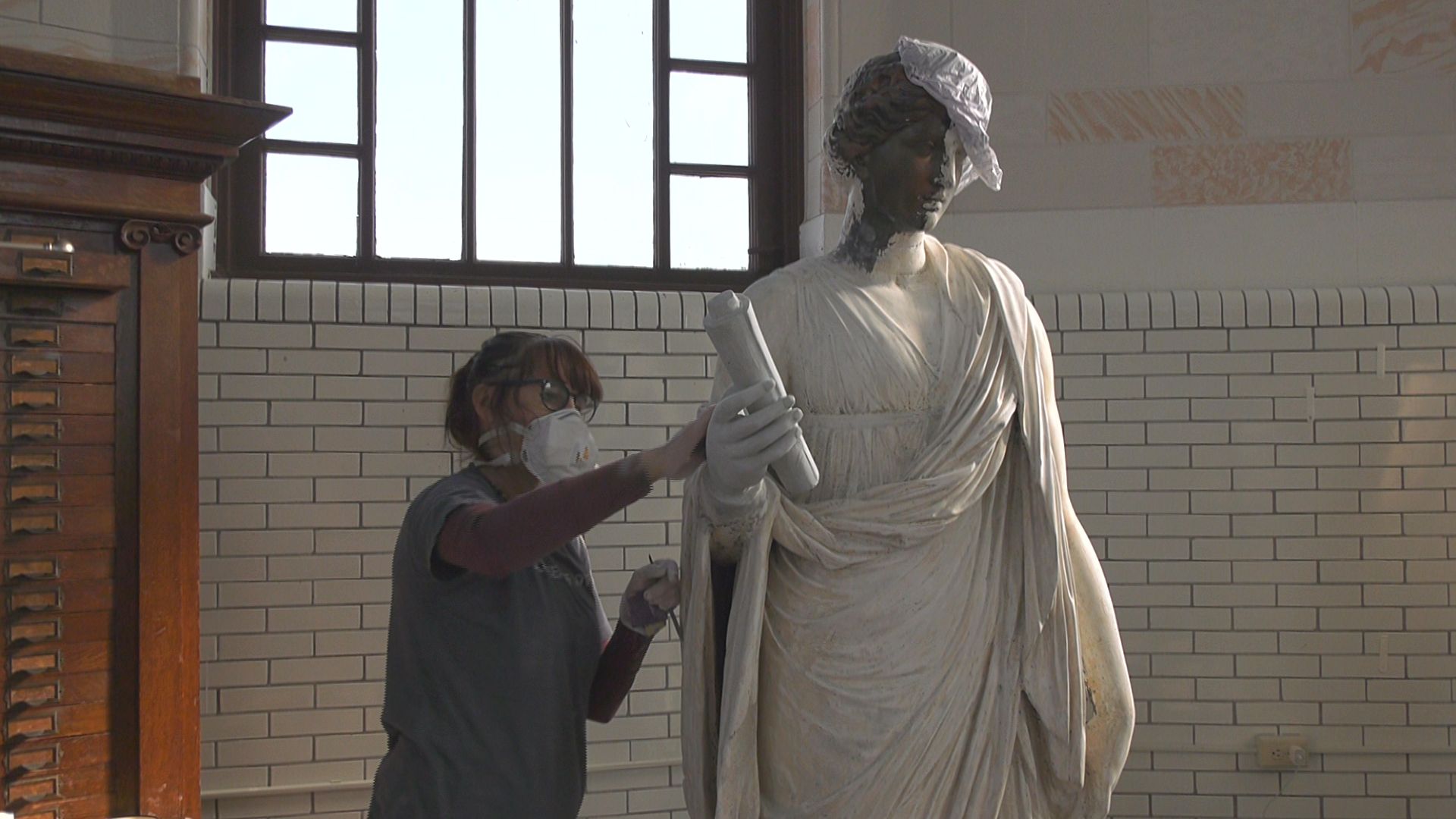
MANISTIQUE, Mich. (WZMQ) – A piece of Manistique and American history is in the process of being restored.
For decades, a marble sculpture of the Greek goddess Urania stood in the halls of Manistique High School. It was a gift from the Class of 1922, commemorating the signing of the Treaty of Versailles and the end of World War I. Over the years, her story was largely forgotten.
“We were oblivious to her,” said Jane Kopecky, who graduated from the high school in the 1960s. “She was hidden in plain sight. None of our teachers knew her history.”
When a new school was constructed in 1975, Urania was moved to the new library. Because the statue was so large, it was placed backstage of the theater.
“She became a prop in a lot of the plays,” Kopecky said. “From there, they decided to move her to the maintenance department. Eventually, they moved her out onto a loading dock. A local citizen then moved her to their house.”
In 2018, late Manistique resident John Anderson wrote a book titled ‘Stique Stories. He recounted a time when he and his classmates moved Urania in front of the principal’s door. That anecdote inspired the Schoolcraft County Historical Society to find the statue.
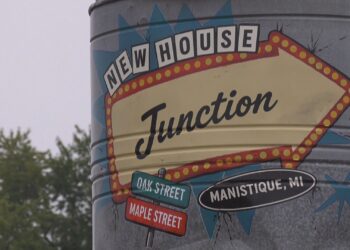
In 2019, Urania was taken to her current home inside the Manistique Water Tower, which the Historical Society has transformed into a museum. Members launched a Urania Fund in hopes of pursuing a full restoration.
“Society leadership had raised a nice amount of money, and then COVID hit,” said lifetime member Lisa Busch. “Things went a little bit sideways, but now we’re back on track. This is a huge, A1 priority for us.”
The Historical Society recruited professional preservationist Renata Palubinskas to return the statue to its former glory. That work includes reconstructing one of Urania’s hands that had fallen off, as well as a scroll she once held.
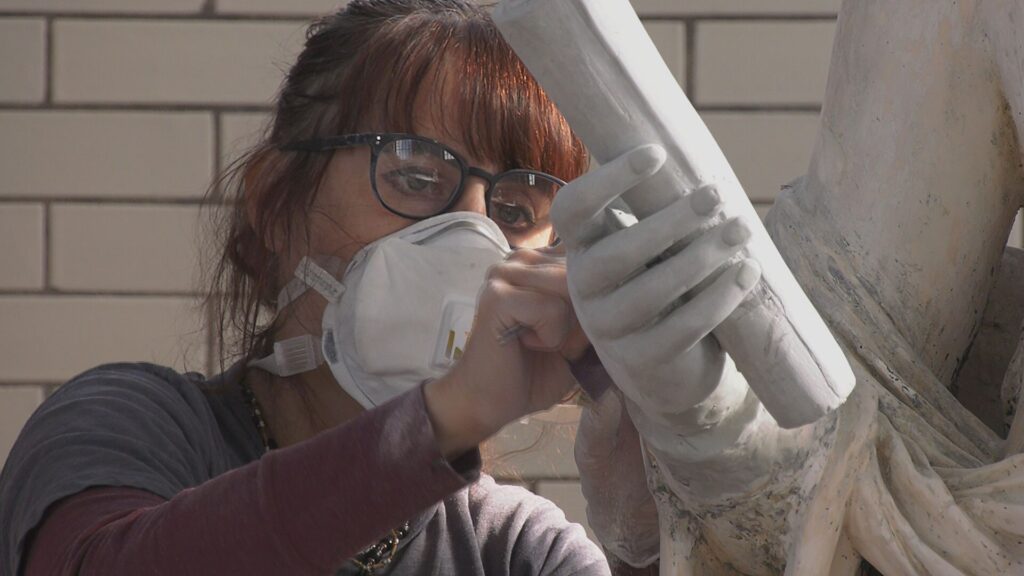
“This is a large marble sculpture, which at some point was overpainted with a bronze color,” Palubinskas explained. “It was more than one layer. There was underpaint of some black tar-looking color first, and then the bronze. I’m removing those two layers of paint. Once it’s done, I will recreate that missing marble-looking color so she will somewhat look like a marble sculpture.”
Through the process, the Historical Society and Palubinskas have learned a lot about Urania’s history.
“Originally, Urania was excavated in ancient Rome,” Palubinskas said. “She was found without both hands and even without a head. She was restored and placed in the Museum of Versailles. Later on, some other Uranias were reproduced from that sculpture.”
However, the history of this particular Urania is uncertain.
“We don’t actually know where she originated,” said Busch. “We’ve communicated with P.P. Caproni and Brother, which is a century-old foundry. They were the ones purchasing statues and busts and everything coming out of Europe. We know that in the 1920s, she was a little over $100, mail order. Higher-level art schools would purchase these models, and then at some point in time, they would sell them to a smaller institution. This could’ve come from a big art school here in the Midwest. We continue to research as her story unfolds, looking for more and more data and detail.”
Whatever this Urania’s origin, Busch says it is the only one the Historical Society knows to exist in the United States.
“Today, she’s priceless,” she said. “She’s very special.”
The Historical Society continues to raise money for the restoration effort, with a total goal of $10,000. With the statue now on permanent display inside the water tower, members hope to keep Urania’s legacy alive for future generations.
“There’s a certain wonder that Urania lends to the eye or the individual,” said Busch. “You think back in 1922, post-war, what a beautiful gift, that symbolism. Peace might be the overarching theme for her moving forward and what she stood for over a century ago.”
Urania is available to view Wednesday through Saturday from 11 a.m. to 3 p.m. There is a donation box set up inside the water tower, but donations can also be made online. Click here to learn more about supporting the restoration project financially.