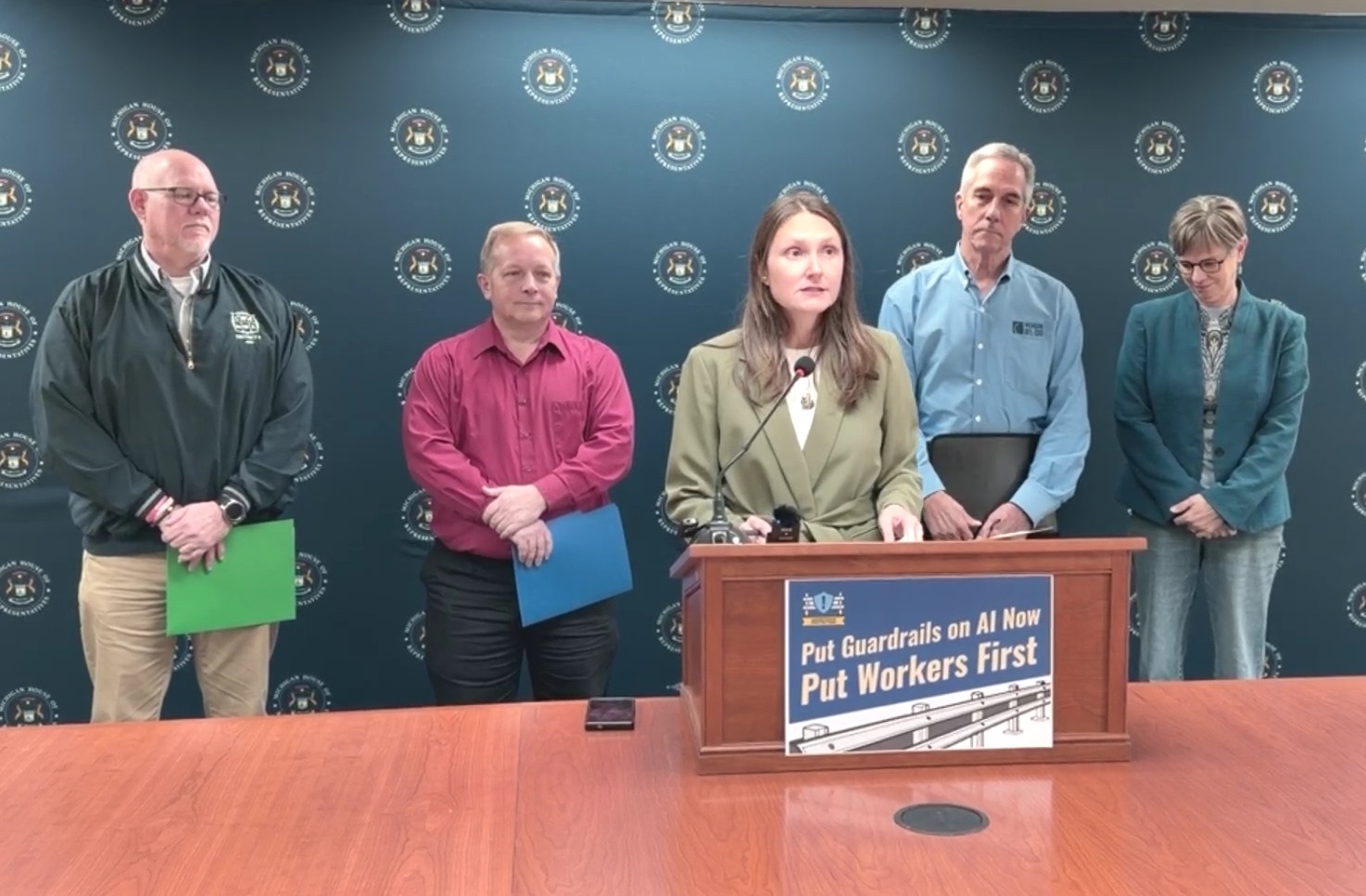
LANSING, Mich. (WZMQ) – Democratic lawmakers joined union leaders Tuesday to announce legislation designed to create guardrails around the use of artificial intelligence in the workplace.
The measure, titled the Responsible AI and Security for Employees Act, would require employers to notify workers if AI monitoring tools are being used, establish standards for how data is collected and stored, and prohibit using AI systems to set wages.
Bill sponsor Rep. Penelope Tsernoglou (D-Lansing) said AI-driven surveillance has become increasingly common and more invasive.
“Artificial intelligence has made these technologies more invasive, more widespread, and more all-encompassing, to the point where your employer can track how many times per day you need to visit the restroom,” Tsernoglou said. “I don’t know about you, but I don’t need anyone monitoring when I go to the restroom.”
Tsernoglousaid the bill does not ban AI tools outright but requires impact assessments, human oversight, and proof that monitoring systems are relevant to job performance.
Michigan AFL-CIO President Ron Bieber said labor leaders view AI as a major challenge facing workers.
“AI should not be a replacement for workers. AI should not be a weapon used to harass, surveil, or intimidate workers,” Bieber said. “AI should be a tool that makes workers’ lives easier.”
Union representatives from the Michigan Nurses Association and the Communication Workers of America also spoke in support of the legislation.
Jeff Breslin, a registered nurse and president of the Professional Employee Council at Sparrow Hospital, said AI tools are increasingly being marketed in health care settings to monitor staff behavior.
“There is an alarming increase in the amount of AI that is out there,” Breslin said. “You cannot replace the judgment of a registered nurse, a human registered nurse, and think that the output of a machine is going to do a better job.”
Breslin warned that algorithms may not account for the nuances of patient care and could lead to discipline based solely on automated outputs.
Supporters said the bill also includes data protection provisions governing how long companies can retain employee data and how it can be used.
When asked about potential legal challenges, Tsernoglou acknowledged that federal action on AI regulation, including a recent executive order from President Donald Trump limiting state-level oversight, could complicate enforcement. However, she said she believes states have a role to play in establishing protections.
Similar proposals are being discussed in states such as California and Massachusetts.
Tsernoglou said she has spoken with some Republican lawmakers about the bill but has not yet secured bipartisan co-sponsors.
“Our workers are of all political parties and probably don’t want to be spied on,” she said.
The bill has been enrolled and is expected to receive its formal reading in the House this week.