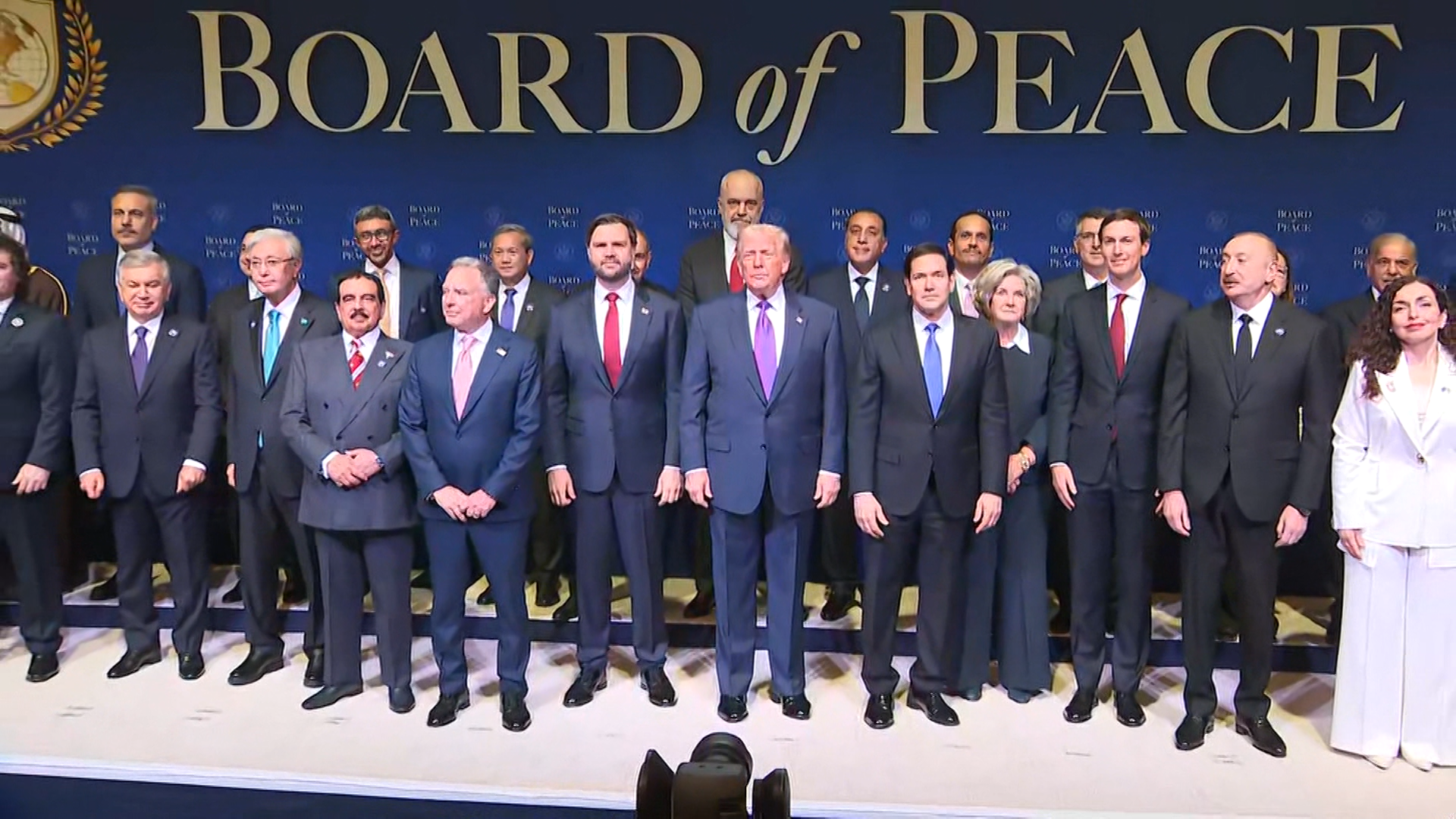
WASHINGTON, D.C. — At the first-ever Board of Peace Summit in Washington, President Donald Trump rolled out new financial commitments and security pledges aimed at stabilizing and rebuilding Gaza.
The administration says it’s a breakthrough moment — but challenges remain over funding gaps and Hamas’ future.
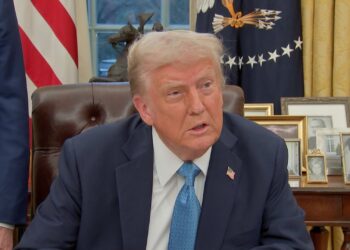
“It’s called the Board of Peace, and it’s all about an easy word to say, but a hard word to produce. Peace,” said President Donald Trump.
Standing before dozens of world leaders, President Donald Trump announced Thursday that nine member nations have committed a total of $7 billion toward Gaza’s recovery, as well as an additional contribution from the United States.
“I want to let you know that the United States is going to make a contribution of $10 billion to the Board of Peace,” said President Trump. “And that number is a very small number when you look at that compared to the cost of war.”
Even with those pledges, reconstruction estimates range between $60 billion and $100 billion, meaning the board’s early commitments represent only a starting point.
Beyond funding, the meeting focused heavily on security.
“Hamas has been, I think they’re going to give up their weapons. If they don’t — they will be harshly met, very harshly met. They don’t want that,” said President Trump.
Several countries — including Indonesia and Morocco — have agreed to deploy forces as part of a proposed international stabilization force. Egypt and Jordan are already training thousands of Palestinian police officers in preparation for a post-conflict transition.
“We have to have some significant peacekeeping, stabilization forces. And it’s a key factor in the 20-point Trump plan,” said Lianne Pollack-David, former adviser to the Israeli prime minister’s office and co-founder of the Israeli Coalition for Regional Security.
Pollack-David describes the troop commitments as meaningful progress, but says some central questions remain unanswered: “On how Hamas is actually going to be demilitarized. We, as Israelis don’t see Hamas agreeing to demilitarize itself,” she said.
Pollack-David also voiced concern over Qatar’s inclusion on the board, citing its previous financial support of Hamas.
“The Qataris were — we have to remember — major backers and funders of Hamas and of the Muslim Brotherhood, which a lot of Israelis see as a completely hostile influence,” she said. “Now, the Qataris are part of the Board of Peace.”
Pollack-David also warns that oversight of reconstruction funds will be critical. She says the issue isn’t just raising money — it’s ensuring it’s directed properly.
“It’s not really a question of how much money. It’s more about how it’s going to be managed and who is actually going to control and monitor it,” said Pollack-David. “We need to make sure that this money goes towards the most important thing — to the schools and to the mosques — to drive positive, moderate influence.”
The White House says the Board of Peace could eventually expand beyond Gaza to address additional conflicts. But for now, its credibility may hinge on whether it can close the funding gap and create a viable security alternative to Hamas on the ground.